Simple Actions and the Greater Web
How Shared World work touches the spiritual self, strengthens connection, and shows how small acts move through the larger web of people, land, tools, and care.
Sections
Quick answer
Shared World's work affects the spiritual self because it pulls people out of isolation and into relationship with soil, tools, neighbors, time, and consequence. A compost bucket, repaired chair, planted bed, approved service hour, or donated tool is not only a task. It is a small change in the web. When people can see that web, they begin to act with more care.
Shared World is practical on purpose. It moves soil, tools, food scraps, furniture, volunteer hours, waivers, service records, and project needs. It asks ordinary questions: who needs this, who can help, what can be repaired, what can be grown, what can be documented, what can be shared?
But practical work is never only practical.
The spiritual self is shaped by what a person touches, repeats, notices, avoids, repairs, and serves. A person who spends years as a consumer is trained to see the world as a shelf. A person who serves begins to see the world as a web.
That is the quiet objective behind much of Shared World’s work: help people see the greater web, then give them a simple place to act inside it.
The web is not an idea. It is the condition we already live in
Every object has a web.
A chair is not only a chair. It is wood or metal, labor, transport, money, use, wear, storage, repair, and eventual disposal. If it is thrown away, the web continues into landfill space, hauling fuel, public cost, and replacement demand. If it is repaired and placed in a volunteer check-in room, the web changes.
A food scrap is not only waste. It is soil fertility that got interrupted. Composting reconnects that scrap to microbes, water, plant roots, gardens, meals, and shared health.
A volunteer hour is not only time. It is a transfer of attention. It may become a planted bed, a repaired tool, a safer event, a signed service letter, a nonprofit report, or a child’s first memory of adults working together.
The greater web is not mystical because it is vague. It is spiritual because it is real and larger than the self.
Why small actions matter
Large systems are built out of small repeated actions.
Food systems are built meal by meal. Waste systems are built item by item. Trust is built promise by promise. Soil is built handful by handful. Community is built name by name.
This is why Shared World puts so much weight on simple acts:
- Offer a usable item instead of dumping it.
- Sign up for a workday.
- Compost food scraps.
- Share a tool.
- Approve hours honestly.
- Teach one skill.
- Plant one bed.
- Write down what happened.
None of these actions look large enough to change a culture. But culture is exactly where repeated actions accumulate.
The spiritual self changes through contact
People do not become whole by thinking only about themselves. They become whole through right relationship: with their own body, with other people, with land, with time, with limits, with responsibility.
Nature connectedness research points in this direction from a psychological angle. Meta-analyses have linked stronger connection with nature to wellbeing and pro-environmental behavior. That does not prove every garden day creates spiritual growth. It does suggest something important: people who feel connected to the living world tend to relate to it differently.
Shared World work gives that connection a body.
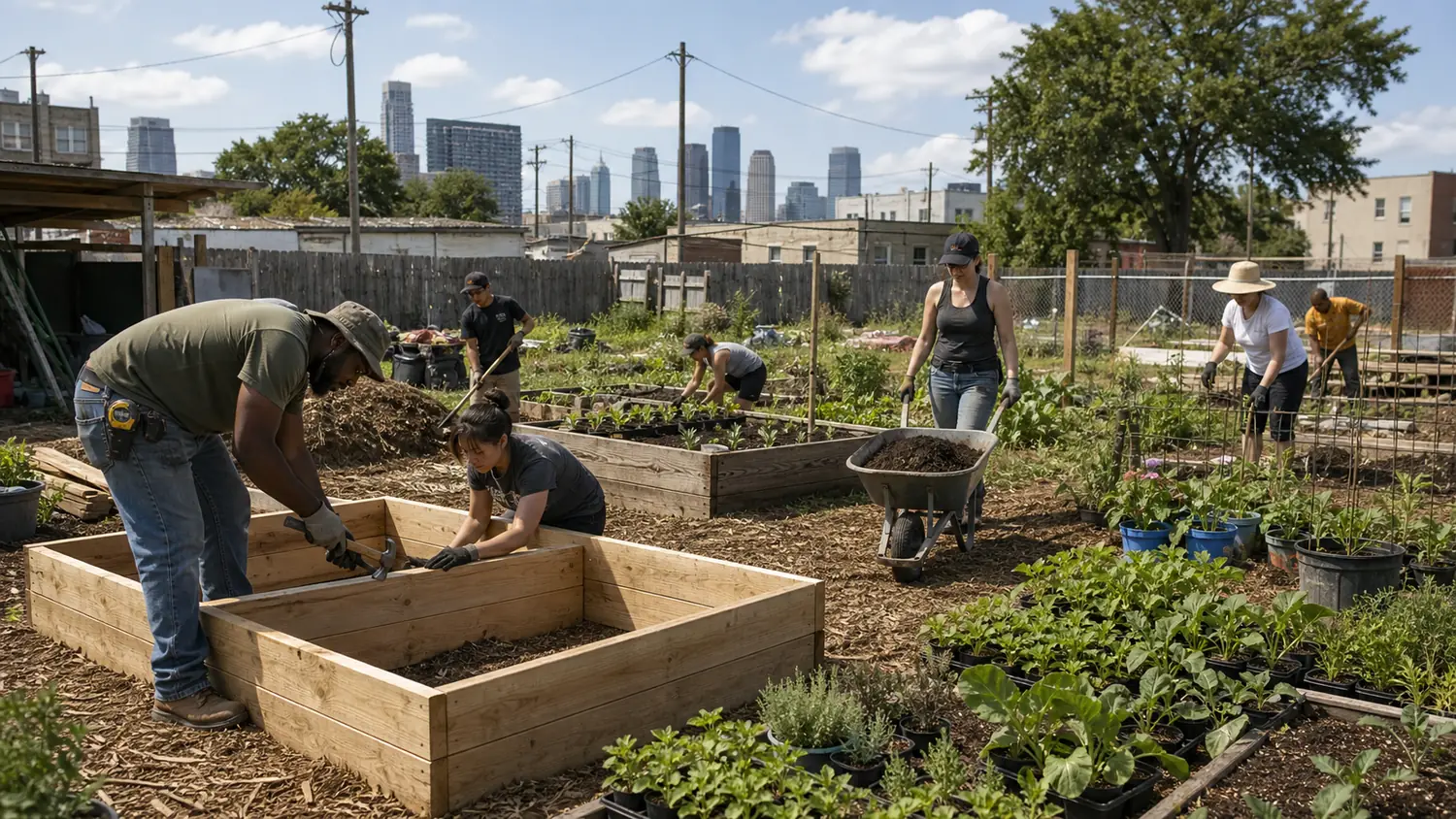
You do not only believe in soil. You carry compost. You do not only believe in community. You show up on a Saturday. You do not only believe in reuse. You clean, sort, repair, and route the item. You do not only believe in accountability. You document the hour.
The self changes when belief becomes practice.
Social connection is part of the web
The CDC identifies social connection as important to mental and physical health, with stronger social bonds linked to longer, healthier lives and better stress management. It also points to community places such as neighborhoods, schools, workplaces, parks, and places of worship as settings where connection can grow.
Shared World adds practical service sites to that list.
A workday can connect people who would never meet otherwise: a donor with a truck, a nonprofit staff member, a volunteer seeking required service, a neighbor with spare seedlings, a retired carpenter, a teenager learning tools, a parent signing a waiver, a caseworker checking eligibility, a gardener protecting soil through heat.
That is logistics with a moral and spiritual consequence. The web becomes visible.
What Shared World does to the web
It turns waste into relationship
When a company offers surplus shelving, a garden site may gain storage. When a donor lists tools, a repair crew may become possible. When food scraps become compost, a waste stream becomes soil.
EPA’s sustainable materials management framework asks people to look at full material life cycles instead of disposal alone. That life-cycle view is spiritually important because it breaks the illusion that objects disappear when we are done with them.
Nothing disappears. It goes somewhere.
Shared World asks: can it go somewhere useful?
It turns service into memory
Unrecorded service is still valuable, but recorded service can travel. It can support a volunteer’s court requirement, school requirement, resume, grant report, nonprofit record, or future trust.
That matters spiritually because honest memory is part of care. A person should not have to beg for proof of work they completed. A community should not claim impact it cannot substantiate.
Records keep the web from becoming fog.
It turns strangers into participants
The consumer system keeps people in separate lanes: buyer, seller, donor, recipient, worker, user.
A living web mixes those roles. The donor may become a volunteer. The volunteer may become a teacher. The recipient may become a steward. The company with surplus may become a partner. The person completing required service may become the person who trains the next crew.
Shared World should make those transitions possible without forcing them.
It turns care into structure
Care without structure fades. Structure without care hardens.
Shared World needs both: waivers, records, schedules, review, resource routing, volunteer profiles, partner workspaces, and public reports. These systems are not bureaucracy for its own sake. They are containers that let care move farther without losing shape.
How one action moves through the web
Imagine one office chair.
It could go to landfill. Instead, someone lists it with a clear photo and honest condition notes. A reviewer approves it. A nonprofit claims it for a volunteer check-in station. A driver picks it up with other useful items. A volunteer cleans it. A site coordinator uses it at a garden launch. A person completing required service sits there to sign in. Their hours are approved. Those hours become a service letter. The garden grows food. Compost from a restaurant supports the beds. A neighbor eats from the harvest.
One chair did not save the world.
But one chair changed direction. It became part of a chain of care instead of a chain of waste.
That is the greater web.
The Netism frame
Netism is the governing parent organization behind Shared World. Public involvement in Netism is not required to work with Shared World, but Netism’s ethical frame matters because it names the deeper logic: free will, balance, care, and points such as environmental harmony, community sovereignty, sacred technology, and transformative action.
Those words should not stay abstract.
- Free will means service must not become coercive belief.
- Balance means a project cannot exploit volunteers while claiming impact.
- Care means records, tools, land, and people must be handled with attention.
- Environmental harmony means waste, soil, water, and energy are spiritual concerns because they are relational concerns.
- Community sovereignty means people should gain capacity, not dependency.
- Transformative action means values have to become work.
Shared World exists where that spiritual frame meets public service.
A practice for seeing the web
Before any action, ask five questions:
- Where did this come from?
- Who touched it before me?
- What will happen if I do nothing?
- Who could be helped if it is routed well?
- What record should exist so the care does not vanish?
Use those questions for food scraps, tools, money, time, water, furniture, volunteer labor, stories, photos, and data.
Seeing the web is not a mood. It is a discipline.
The result
When people see the web, they become harder to numb.
They notice waste differently. They notice loneliness differently. They notice soil differently. They notice their own hands differently.
This is the spiritual impact of practical work: the self becomes less sealed off. It starts to understand that every action enters a living field of consequence.
Shared World cannot make that realization happen for anyone. It can only create places where the realization becomes easier: a garden bed, a repair table, a resource route, a service record, a shared meal, a workday, a piece of land made healthier by human care.
The greater web is already here.
The work is to act like we can feel it.
Sources and further reading
Common questions
Is Shared World asking people to join Netism?
No. Shared World is governed by Netism's values, but public involvement in Netism is not required. People can volunteer, donate, partner, or receive support without joining Netism.
What does the greater web mean in practical terms?
It means every action has relationships around it: land, water, labor, tools, transport, waste, food, neighbors, records, and future use. Seeing the web means acting with awareness of those relationships.
How can a simple action have spiritual impact?
A simple action can change attention, responsibility, and connection. Repairing, planting, composting, sharing, or serving can move a person from isolation into care, and that shift affects everyone linked to the work.
Related guides
Put this into work
Bring a project need, offer materials, or join a local service shift.